Re-Examining the Barbara Stagner – Benjamin Denny Connection

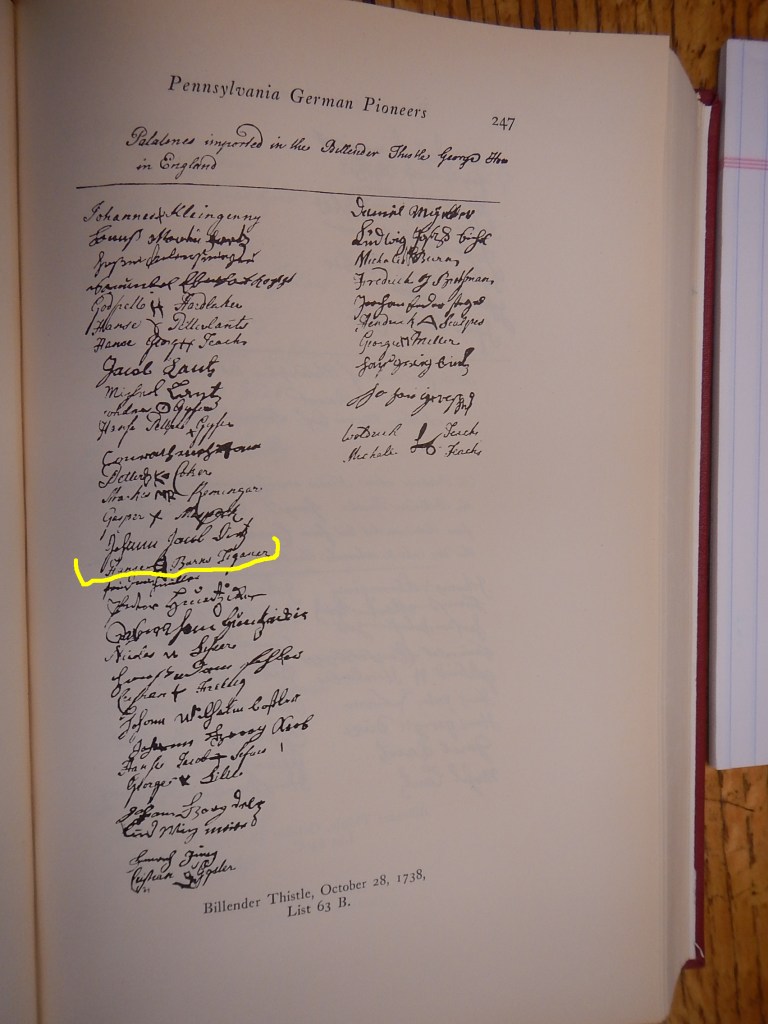
For many years, numerous online family trees have identified John Barney Stagner’s daughter Barbara Stagner as the wife of Benjamin Denny (Denney). However, despite the widespread acceptance of this claim, no primary record has yet been located that directly identifies Benjamin Denny’s wife Barbara as a daughter of John “Barney” Stagner of Rowan County, North Carolina.

The Traditional Assumption

The commonly accepted theory appears to be based upon two separate facts:

  1. John “Barney” Stagner’s will names a daughter named Barbara.
  2. Benjamin Denny is known to have had a wife named Barbara.

Many researchers have connected these two women and concluded that Barbara Stagner married Benjamin Denny. To date, however, no marriage bond, deed, probate record, church record, or other contemporary document has been produced that directly establishes this relationship.

Evidence Suggesting an Alternative Possibility

A significant record appears in the 9 March 1835 will of Frederick Gross of Stewart County, Tennessee. In that will, Gross wrote:

“…said Barney and Frederick Gross to support my wife Elizabeth Gross and my mother in law Barbary Stagner during their lives…”

This record establishes that:

  • A woman known as Barbary Stagner was living in Stewart County, Tennessee, in 1835.
  • She was the mother-in-law of Frederick Gross.
  • She was identified in a legal document by the surname Stagner.

The Gross and Stagner Connection in Rowan County

The Tennessee record becomes more interesting when viewed alongside earlier Rowan County records.

Research indicates that George Stagner, a grandson of John “Barney” Stagner, lived adjacent to Frederick Gross on Fourth Creek in Rowan County, North Carolina. This was the same general neighborhood where Barney Stagner and his descendants resided.

A George Stagner also appears in Stewart County, Tennessee, records around 1810-1811 before later returning to Warren County, Kentucky, where he eventually died.

The connection between:

  • the Rowan County Stagners,
  • Frederick Gross,
  • Stewart County, Tennessee,
  • and the appearance of Barbary Stagner in Frederick Gross’s will,

suggests that Barbary Stagner of Stewart County may have belonged to the Rowan County Stagner family.

The Elizabeth Hallis Marriage

A Rowan County marriage bond dated 21 October 1791 records the marriage of Frederick Gross and Elizabeth Hallis (Hollis).

If this is the same Frederick Gross found later in Stewart County, then one possible interpretation is:

  • Barbary Stagner married a Hallis/Hollis man.
  • Their daughter Elizabeth married Frederick Gross in 1791.
  • Frederick later referred to his mother-in-law by her Stagner surname in his 1835 will.

While this remains a hypothesis, the chronology fits reasonably well.

If Elizabeth was born about 1770, then her mother Barbary would likely have been born around 1750, placing her within the same generation as the known children of John “Barney” Stagner.

The Lunenburg County Question

Some researchers have attempted to identify John Stogner of Lunenburg County, Virginia, as the same man as John “Barney” Stagner of Rowan County, North Carolina.

This identification should be treated with caution.

Records indicate that other Stogner families were present in the Lunenburg area during the same period, and some of those families later migrated into North Carolina, particularly into areas that became Montgomery County.

The existence of multiple Stogner families weakens the argument that every record for a “John Stogner” in Virginia must refer to the Rowan County Stagner patriarch.

At present, the evidence does not conclusively prove that the Lunenburg County John Stogner and Rowan County John Barney Stagner were the same individual.

Current Assessment

Based on presently known evidence:

Well Supported

  • John “Barney” Stagner had a daughter named Barbara.
  • Benjamin Denny had a wife named Barbara.
  • Barbary Stagner was living in Stewart County, Tennessee, in 1835.
  • Barbary Stagner was the mother-in-law of Frederick Gross.
  • Frederick Gross and members of the Rowan County Stagner family were associated neighbors on Fourth Creek.

Not Yet Proven

  • Barbara Stagner, daughter of John Barney Stagner, married Benjamin Denny.
  • Barbary Stagner of Stewart County was the same woman as Benjamin Denny’s wife.
  • John Stogner of Lunenburg County and John Barney Stagner of Rowan County were the same man.

Conclusion

The 1835 Frederick Gross will provides direct evidence for the existence of a Barbary Stagner connected to the Rowan County Stagner-Gross neighborhood network and later found in Stewart County, Tennessee. At present, this evidence appears stronger than the commonly repeated but undocumented claim that Barbara Stagner married Benjamin Denny.

Further research into Rowan County records, Stewart County probate records, land transactions, and Hallis/Hollis family records may eventually determine exactly where Barbary Stagner fits within the Rowan County Stagner family. Until such evidence is found, the alleged marriage of Barbara Stagner to Benjamin Denny should be regarded as unproven rather than established fact.

Additional Note: The Denney connection appears to trace back at least in part to compiled family histories, but that no underlying source documentation has yet been identified.
Stagner Y-DNA Analysis

I had the experience to attend Diahan Southard’s weeklong class on Y-DNA and finally understand enough to be dangerous. So I will try to explain what I have learned in terms of Stagner YDNA results experienced this far.

YDNA is passed down from father to son. There always the possibility that the DNA could change during this process, but the change process from one generation to another is fairly slow, so minimal changes are expected in known relationships. It seems to be generally agreed that 5 or less deviations indicates a close relationship. In theory YDNA should be able to be valuable for several generations back.

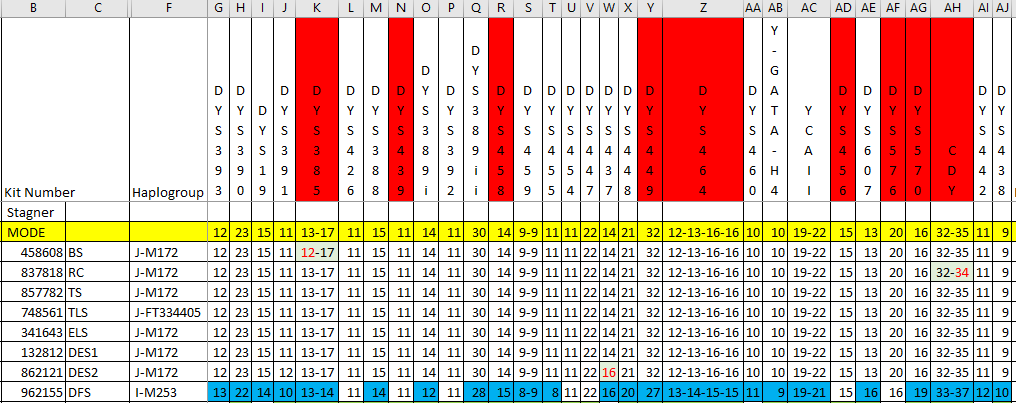
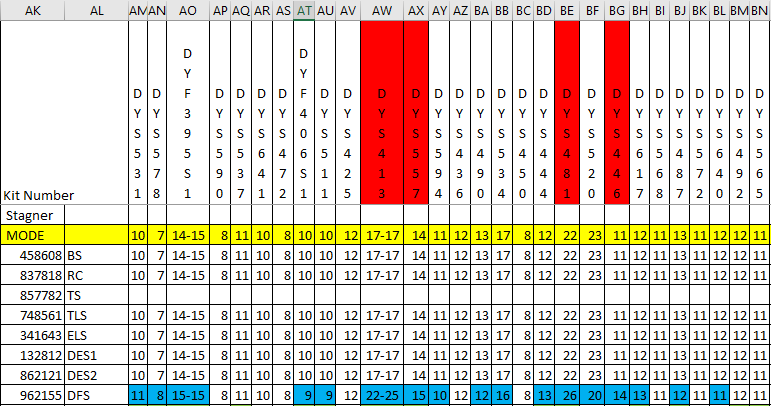
The following tables summarize those results. The table consists of a list of the YDNA markers tested that are shown in the first row. These markers represent areas where sections of the DNA repeat. The number of times the DNA repeats is the number defined for each individual in the line below. The line highlighted in “yellow” is called the mode line and that is the most common value found for those of similar ancestry.

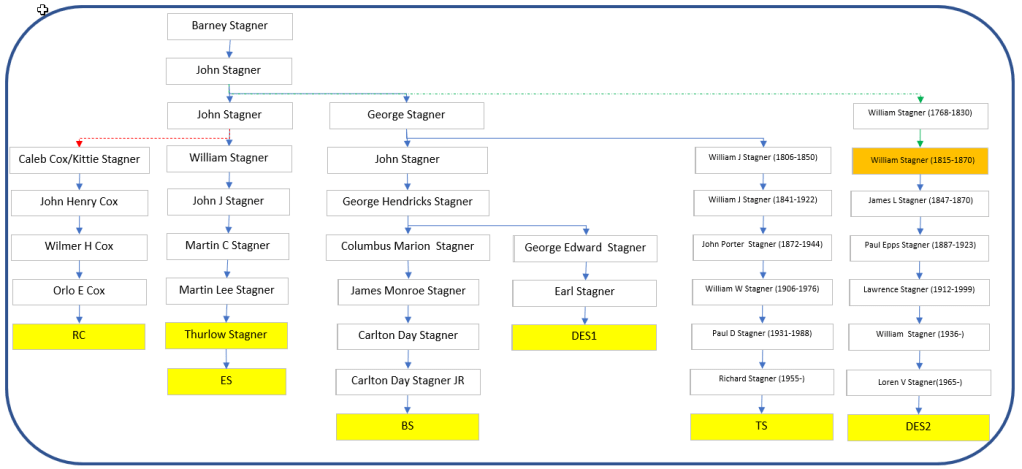
Frame 1 lists the results for the first 37 markers. It should be noted that the first seven men tested had very similar Y-37 DNA, suggesting a close relationship. BS, RC, and DES2 had one variation from the standard.

Stagner YDNA Results – August 2021 – Frame 1

Frame 2 shows the results for additional markers tested for those having done a Y67 test. For those testing to Y-67 level, there were no variations from the standard value shown in yellow.

Stagner YDNA Results – August 2021 – Frame 2

Frame 3 lists the additional markers tested for those have done a Y111 test. For those testing to Y-67 level, there were no variations from the standard value shown in yellow. For those testing to Y-67 level, there were no variations from the standard value shown in yellow. RC had one variation from the standard at Y-111.

Stagner YDNA Results – August 2021 – Frame 3

All of this suggests the conclusion, that seven of the guys eventually go back to John Stagner, son of Barney Stagner.

Stagner Genealogy suggested by Results of DNA Testing

TS, ES, BS, DES1, TS are clearly descendants of John Stagner.

DES2 has known relationship back to William Stagner born 1815 in North or South Carolina. However, the father of this William is unclear from genealogical data. This Y-DNA definitely suggests that DES2 is a descendant of John Stagner and Barney Stagner and based on offspring of John Stagner, the most likely candidate is William Stagner and Susanna Gibson his wife, who moved from Warren County, KY to Crawford County, Arkansas. Gibson, oldest son of William eventually moved to Caldwell County, Texas and his possible brother William was in nearby Colorado and Fayette County, so this makes some sense. However, William Stagner (1815-1870) gives his birth as North Carolina in 1850 census and South Carolina in the 1860 census. This is inconsistent with his father being William (1768-1830) because as far as known, William was no were near NC or SC in 1815, as records shown him in Warren County, KY at the time. So the only way this could have been his father was if William (1815-1870) did not know his actual state of birth and maybe assumed based on where his father was born.

Looking at the other possible brothers of William (1768-1830):

  • John (1766-1842) had a son William (1790-1846)-home Butler County, KY
  • George (1770-1840) had a son William J (1806-1850)-home Simpson County, KY
  • Nathan (1770-1857) had a son George William (1827-1867)-home Benton County, TN
  • Barnabus (1773-1836) had a son William (1813-aft 1894)-home Stewart County, TN
  • Jeremiah (1783-1843) had no son William.
  • Thomas (1783-????) nothing is known about his family
  • Andrew (1792-1873) has a son Henry William (1822-1900)

So, of the possible known sons of John Stagner(1740-1820), those with known sons William, other than William(1768-1830) do not fit the story to be a father of William (1815-1870). William (1768-1820) was the only known son of John (1740-1820) to have ventured past the Mississippi in Arkansas, and his offspring in Texas where William(1815-1870) died.

It must be pointed out there there is NO solid evidence who were the sons of John Stagner (1740-1820). The above list of sons was determined only what makes sense by looking at name and location.

There is another possibility. There is anecdotal family history stating that 3 brothers: John, William, and Henry traveled west and bought land in Warren County, KY. The only evidence that I have found for a Henry Stagner in Kentucky in the early 1800s was for a Henry Stagner found on tax lists in Christian County, KY on the Little River. No positive evidence has been found linking this Henry to any other Stagners either in Kentucky or Tennessee other than the geographical proximity. So it is possible that this Henry could have been a son of John (1740-1820) and perhaps was the father of William (1815-1870).

There was another Henry Stagner found in Sumner County, TN from about 1809 to the 1820 census. There is an individual in this census that could have have been William (1815-1870). Could this Henry have been the same one found in Christian County in early 1800s? It is not certain where the Sumner County Henry came from! But, it is believed that he was the Henry Stagner found in Greenville County, SC in the 1800 census. If so, and if William (1815-1870) is descended from him, then it might explain why he stated he was born in SC in 1860 census. What is clear is that Greenville County/Sumner County Henry cannot be the same Henry as found in Christian County, definitely were two different Henrys as they were in distinctly different locations in 1800.

The last tester in the list YDNA test list is DFS. He is a Stagner male and his descendancy is from Henry Stagner of Trigg County, KY.

John C Stagner

I often get questions about John C Stagner who died in Pike County, AL in 1879, born in SC in 1795. The main question being who was his father. There has not been any direct evidence found mentioning John in a Stagner family at a young age. However, indirect evidence directly points to the father of John C Stagner as William Stagner of Lexington County, SC. The 1800 census for William Stagner (looks like and indexed as Hagner) lists 3 males under 10. One of these males is likely John C. The other are likely brothers William Stagner and Daniel Stagner. There is no 1810 census for William Stagner, but there is for “Widaw” Stagner, indicating that William passed before 1810. The 1810 census shows a 16-25 year old male that could have been John C, but at 15 without a father, who knows where he was at the time of census. This Widow Stagner disappeared from records after 1810, so presumably she died or remarried.

I am not sure what happened to John C’s possible brother William, but I believe that he died after 1820 as he was shown in Lexington County, SC 1820 census. A Rachael Stagner was found in 1830 in Jasper County, GA and latter in Tallapoosa County, AL. Rachael is believed to have been the spouse of William. This all indicates a trend of this Stagner family moving west.

Additional support is that another possible brother Daniel Stagner was found in Jasper County, GA in 1820 census.

So beginning around 1810 to 1820 the Stagners of Lexington County were moving West. None were found in any census records in South Carolina after 1820.

The only other Stagner in SC at this time was Henry Stagner, 1800 census in Greenville County. He was older and there were no young males in census. This Henry was found in Buncombe County, NC in 1810. Although they may have been related, there is not proof, but John C most certainly was not a son on Henry. Curiously there was a John Stagner who enlisted in the Army in 1814 in Greenville, SC. This might have been John C, it would not have been that far from Lexington to Greenville.

More detail can be found in the section on Daniel Stagner and his family. Daniel Stagner